Ten names on a dropdown menu don't tell you much. Grand Haven and Spring Lake sound like the same lifestyle until you've actually stood on both waterfronts. Hudsonville and Jenison both get called "family markets," and that label hides more than it explains. If you're moving into West Michigan, or you already live here and you're weighing a move to a different part of it, the town names alone won't tell you where you belong.
I split my business into two clusters because that's actually how these markets behave. The Lakeshore, where water access and lifestyle drive the decision. And the Grand Rapids Area, where commute, schools, and square footage drive it. Every one of the ten communities below sits in one of those two worlds, and once you know which world fits your life, narrowing down to a specific town gets a lot easier.
Before you pick one off a list, though, there's a method I walk every client through, and it has nothing to do with an agent's opinion of a place. Here's how see if a neighborhood may be right for you.
I've had clients buy a home, move in, and realize a few months later they don't actually like the neighborhood. Not the house. The neighborhood. By then they're stuck, and getting out usually means selling again sooner than anyone wants to.
Here's the honest part most buyers don't know: there's a real limit to what I'm allowed to tell you. Fair housing law and our code of ethics mean I can't say "this area has a lot of crime" or "I wouldn't move here." That's not me being cagey. It's the Fair Housing Act, and it exists for good reason. But it also means a straight answer on that specific question isn't one I'm allowed to give, no matter how well I know the area.
So here's what actually works instead.
Call the schools. Not just the ratings you find online. Call the district directly and ask questions. School staff will talk to you about a community in ways an agent legally can't.
Call the local police department. They're not bound by fair housing rules the way I am. Ask about crime rates, demographics, what kind of calls they typically run in that area. It's one of the most useful fifteen-minute phone calls a buyer can make before writing an offer.
Drive the neighborhood at three different times of day. I tell every client the same thing: go at 7 a.m., go at noon, and go back at 8 or 9 p.m. A street that feels calm at lunch can turn into a school-bus bottleneck a few hours later, or go dead quiet after dark in a way you weren't expecting. You only get a true read on a place by seeing it more than once.
This is one of the biggest decisions you'll make. A week of homework costs you almost nothing next to the cost of buying in the wrong place.
Five towns, one thing runs through all of them: real, working water, not a marketing line. Grand Haven sits where the Grand River, Michigan's longest river, finally empties into Lake Michigan. Spring Lake sits on the water that feeds into that same river just before it opens up. Norton Shores and North Muskegon each wrap around their own inland lake, Mona Lake and Muskegon Lake, each with its own channel out to the big one. Holland runs along Lake Macatawa before that opens into Lake Michigan at Holland State Park.
Buyers who end up in this cluster are usually optimizing for something you don't get ten minutes east: a boat you can actually put in the water, a downtown you can walk to, a specific lake your week is going to orbit. That's a different calculation than the one families make in the Grand Rapids Area, where commute time and school boundaries carry more weight than a dock.
The rhythm here is seasonal too. Marina traffic, tourist weekends in July, a version of these towns in February that a lot of buyers never see before they sign. See a lakeshore town in more than one season before you commit to it.
Each of these five carries its own personality inside that shared identity. Here's the real difference.
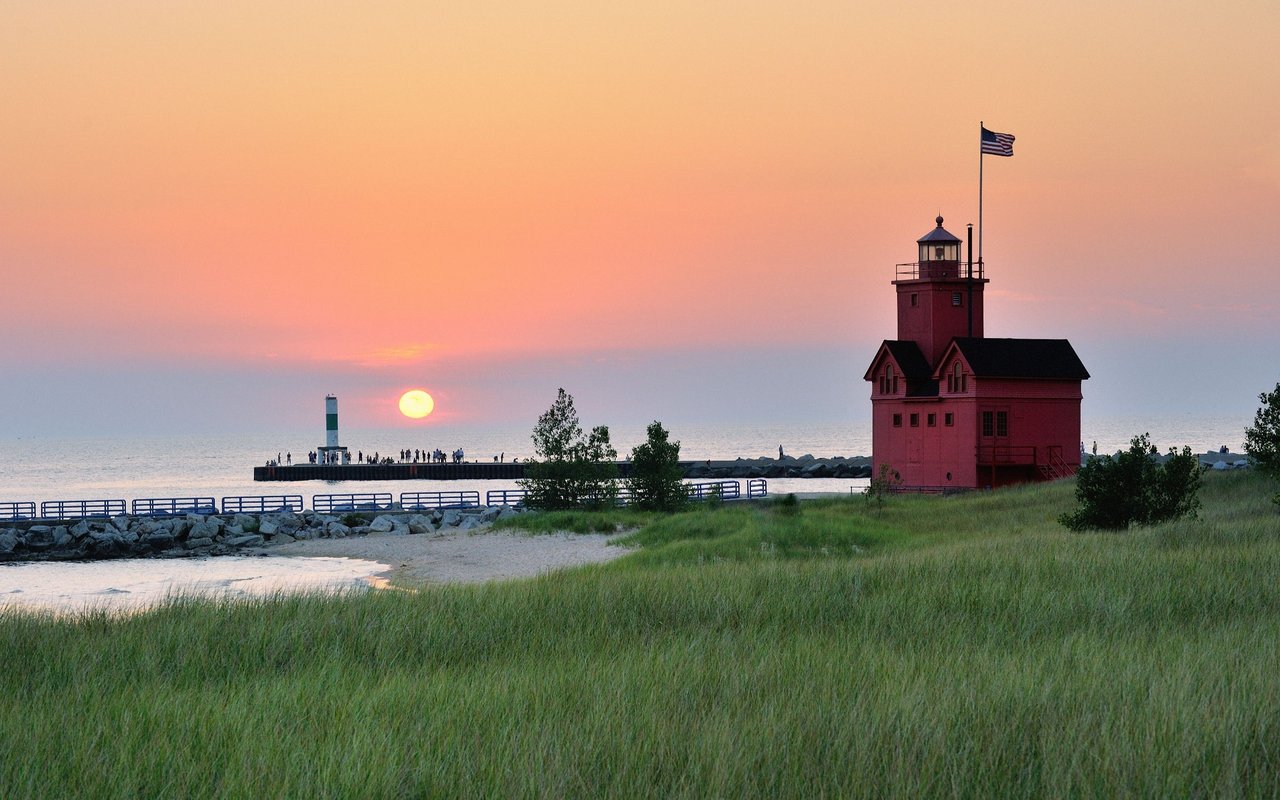
Grand Haven's identity is built around a stretch most residents have actually walked. The boardwalk runs two and a half miles along the harbor and the Grand River, out to the pier and the two red lighthouses connected by a steel catwalk, one of the most photographed lighthouse pairs in the Midwest. Highland Park, one of the city's most historic neighborhoods, sits close enough that you can walk to that view most mornings. That's not a lifestyle brand. That's what buyers here are actually paying for.
Spring Lake sits just upstream on the water that feeds into the Grand River before it opens into Lake Michigan at Grand Haven. Same boating access, same downtown-adjacent feel, fewer people competing for it at the listing level.
Neither market waits around for buyers to make up their minds. I worked with a young couple on a tight budget who toured house after house before they landed on a for-sale-by-owner property that actually fit. We wrote the offer late on a Saturday night, before anyone else had a chance to see it.
Norton Shores and North Muskegon sit in the same lakeshore cluster, a step down from Grand Haven's price point without giving up water access. Norton Shores wraps around Mona Lake, an all-sports lake with its own narrow channel out to Lake Michigan. North Muskegon sits on the shore of Muskegon Lake, the bigger water just West of it. Both trade some of Grand Haven's walkability for more space, more privacy, and a quieter pace.
What each town is actually like day to day, the buyer profile, the trade-offs on rural-adjacent infrastructure, and the real conditions worth checking before you make an offer, lives on the Norton Shores and North Muskegon pages.
Holland is the one town in this cluster that isn't built around a channel. The identity here runs on Dutch heritage, a walkable downtown along 8th Street, and Lake Macatawa opening into Lake Michigan at Holland State Park a few miles out. Unlike the towns north of it, demand doesn't disappear in the off-season, the community identity carries through winter the same way it does in July.
What actually living there looks like day to day, buyer profile, price point, and trade-offs, lives on the Holland page.
Five towns, a different thread this time: distance to Grand Rapids, and what that distance buys you. Grandville sits along the Grand River about eight miles southwest of downtown. Jenison, in Georgetown Township, runs about twelve minutes from downtown and closer to thirty from Lake Michigan. Hudsonville sits along I-196 halfway between Grand Rapids and Holland, one of the fastest-growing areas in the state because of its renown schools system, which is consistently driving home prices in rapid upward tren in comparison to surrounding communities. East Grand Rapids wraps around Reeds Lake with its own nationally ranked school district. Also famously known for Gas Light Village and the the high school with athletic field views of reeds lake -- the feel here is out of a magazine. Ada sits along the Grand River east of the city, inside the Forest Hills school district and is one of the new fastest growing housing markets in the Grand Rapids area. Buyers who end up in this cluster are optimizing for something different than the lakeshore towns fifteen minutes west: commute time, school boundaries, and square footage, not a marina. A move-up family comparing Grandville and Jenison is asking a different question than a Grand Haven buyer. They're asking how many minutes to the office and which elementary school their kids will walk into, not what the view looks like from the porch.
There's no real seasonal rhythm here the way there is on the lakeshore. Demand holds steady through the school year and softens slightly in the dead of winter, same as most inland Midwest markets. The bigger variable is which of these five towns actually fits a specific family's budget and school priorities.
Each of these five has its own personality inside that shared identity. Here's what to expect on each one.
Grandville and Jenison sit right next to each other in this cluster, both built around the same move-up family logic: square footage, school district, and commute time carry more weight than any lifestyle narrative. Grandville runs along the Grand River closer to the city. Jenison, a few minutes further out in Georgetown Township, trades a bit of commute time for more room and a quieter, small-town feel.
What each town actually offers, school boundaries, price per square foot, and the trade-offs between them, lives on the Grandville and Jenison pages.
Hudsonville gets its own section instead of getting paired off, and that's deliberate. It's one of the four markets I've told my own team I want to build around, and it's one of the tightest inventory markets on the west side. The city sits along I-196 halfway between Grand Rapids and Holland, and it's one of the fastest-growing areas in the state, still carrying its small-town, agricultural roots even as it grows.
What that growth actually means for buyers and sellers, inventory levels, school corridor strength, and how fast well-prepared homes move, lives on the Hudsonville page.
East Grand Rapids and Ada are the premium end of this cluster, small, established communities where presentation and finish level carry more weight than almost anywhere else in the region. East Grand Rapids centers on Gaslight Village, a walkable downtown a few blocks off Reeds Lake. Ada's revitalized village center and farmers market sit inside the Forest Hills school district, one of the strongest in the state.
I'll say it plainly: East Grand Rapids has some of the toughest competition in West Michigan, agents who've built their whole business around this one market for decades. I'm building here anyway, because it's a place I genuinely want to spend my time, not just a market I picked for the numbers.
What buyers should actually expect, finish-level expectations, the competitive buyer pool, and price point, lives on the East Grand Rapids and Ada pages.
Ten towns, two very different ways of living, and only one that's actually right for what you're trying to do next. If you've read this far and you still can't tell whether you're a Lakeshore person or a Grand Rapids Area person, that's exactly the conversation worth having before you start touring homes.
Call me directly at (616) 800-8876, or schedule a conversation and I'll walk through your timeline, your priorities, and which of these ten communities actually fits.
Serving homeowners and buyers in Grand Haven, Spring Lake, Norton Shores, North Muskegon, Holland, Grandville, Jenison, Hudsonville, East Grand Rapids, Ada, and surrounding West Michigan communities.
Don't stop at online ratings. Call the district directly and ask questions, and call the local police department too, since they can speak to crime and demographics in ways a real estate agent legally can't. The full method is above, in "How Do You Choose the Right Neighborhood in West Michigan."
Sometimes, but the premium has to be supported by actual comparable sales, not assumed just because a listing says "lake access." My Seller's Guide breaks down what actually drives pricing in each of these markets, on the water and off it.
Yes. Lakeshore listings follow a seasonal rhythm. Tourist season drives up competition and pricing in the summer, while winter tends to bring more serious, less crowded buyers. The Grand Rapids Area holds steadier year-round, tied more to the school calendar than the tourist calendar.
More than most buyers expect going in. Jenison runs about twelve minutes from downtown Grand Rapids. Grand Haven runs closer to thirty-five. That's not a small difference if you're commuting five days a week, and it's worth mapping out before you fall for a specific town.
Start with a home valuation so you know what you're working with, then we can talk through which of these markets actually fits where you're headed next.